From Selling Rooms to Engineering Profit
In today’s rapidly evolving hospitality landscape, relying exclusively on room revenue is no longer a sustainable growth strategy. Market volatility, rising operational costs, increased competition, and changing guest expectations have forced hotels to rethink how they measure success. Filling rooms is important, but it is no longer the ultimate objective.
Progressive hotels are therefore moving beyond Traditional Revenue Management (RM) and embracing Total Revenue Management (TRM). While RM focuses primarily on optimizing room rates and occupancy, TRM takes a broader and more strategic view. It analyzes the complete revenue ecosystem of the property and aligns all departments toward a common financial goal.
This evolution fundamentally redefines performance.
It shifts the mindset from simply “occupying rooms” to intentionally engineering profit across the entire guest lifecycle. Every touchpoint, from booking to check-out, becomes an opportunity to generate incremental value. The room is no longer the final product; it is the gateway to a wider commercial strategy.
Under TRM, success is not measured solely by how many beds are filled, but by how much total contribution each guest generates. The focus expands from short-term room revenue to long-term profitability, asset efficiency, and total guest value.
Hotels must move from selling inventory to designing profit-driven experiences.
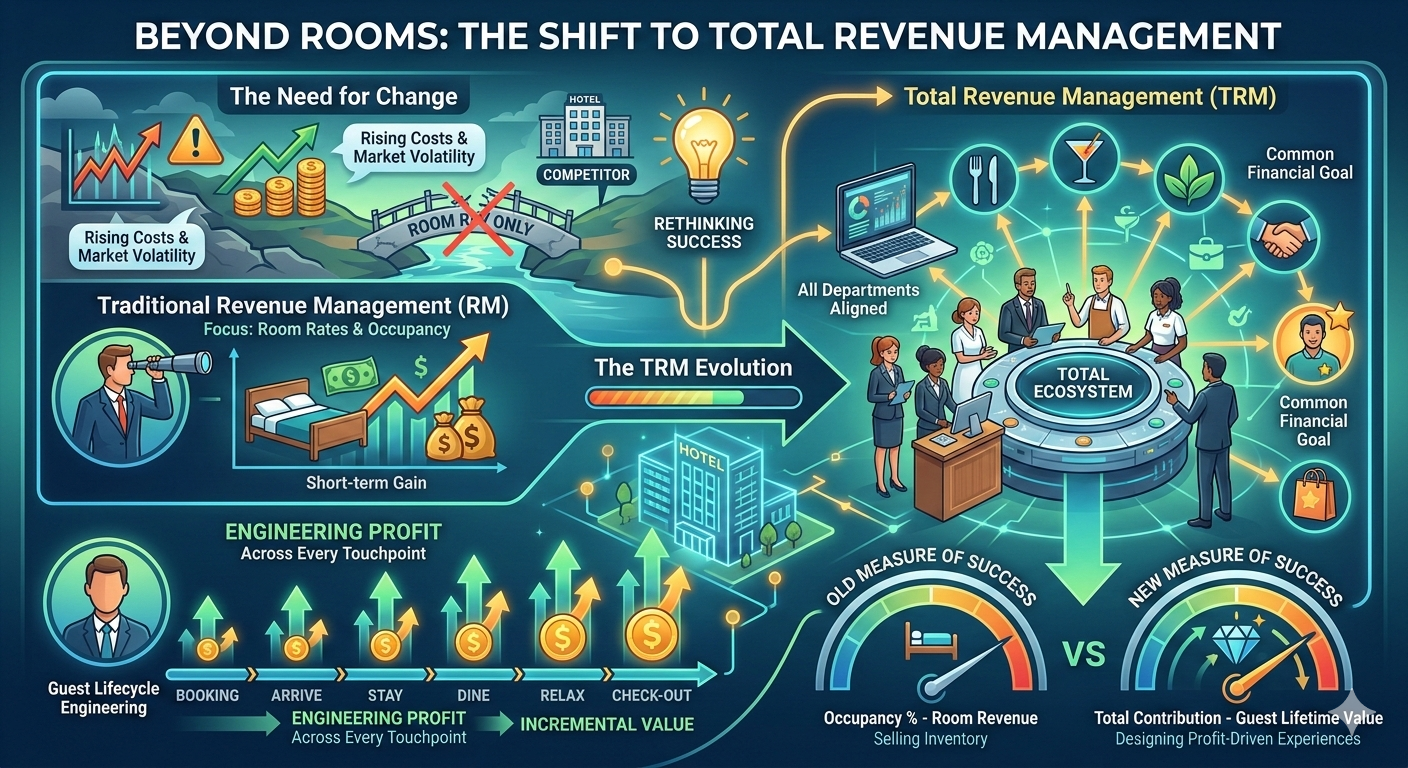
Perspective: Rooms as Products vs. Hotels as Revenue Platforms
Traditional Revenue Management was built around a simple assumption: the hotel’s core product is the room. Success, therefore, meant optimizing occupancy, average daily rate, and ultimately RevPAR. In this model, the property is treated largely as a collection of perishable room nights, units of inventory that must be sold before they expire.
Total Revenue Management reframes that logic entirely.
Instead of seeing the hotel as “rooms to sell,” TRM views it as a fully integrated business platform, a multi-dimensional revenue ecosystem where every square meter has earning potential. Rooms are still important, but they are only one component of a broader commercial strategy.
In this expanded perspective:
The restaurant is not just an amenity, it is a revenue driver with its own demand curves.
The spa is not a cost center, it is a margin opportunity.
Meeting rooms are not simply space, they are high-yield assets when bundled strategically.
Even parking, coworking areas, and wellness facilities become measurable contributors to profitability.
I believe this mindset shift is subtle but powerful.
Room-centric thinking asks:
“How do we sell tonight’s remaining inventory at the best possible rate?”
Platform thinking asks:
“How do we maximize the total lifetime value of the guest occupying that room?”
This approach encourages cross-department collaboration. A guest booking a discounted room rate may represent far greater value if they are likely to dine in-house, book treatments, host meetings, or extend their stay. The room becomes the entry point to a broader revenue journey.
Operationally, this means:
Pricing decisions are made with total spend impact in mind.
Marketing campaigns promote bundled experiences rather than isolated room discounts.
Forecasting models incorporate ancillary revenue streams alongside occupancy projections.
Performance reviews evaluate the profitability of the whole asset, not just the bedroom division.
Ultimately, the shift from “inventory management” to “asset orchestration” transforms the commercial strategy of the hotel. It moves leadership from managing departments independently to steering a coordinated revenue platform designed to extract maximum financial performance from every guest interaction.
In the TRM framework, a hotel is no longer just a place that sells rooms.
It is a dynamic revenue engine where every outlet plays a strategic role in driving sustainable profitability.

Objective: Revenue Growth vs. Profit Optimization
Classic Revenue Management is traditionally focused on maximizing top-line performance. The primary objective is clear: increase Average Daily Rate (ADR), improve occupancy, and grow RevPAR. Success is measured by how much room revenue is generated within a given period. However, revenue alone does not equal profitability.
Total Revenue Management expands the objective from pure revenue growth to true profit optimization. Instead of looking only at how much money is coming in from room sales, TRM evaluates contribution margins, cost structures, and the overall financial impact of each segment, channel, and booking decision. This means analyzing not just revenue, but net value.
Through advanced displacement analysis and profitability modeling, hotels can assess the full economic contribution of a reservation. For example, a corporate group negotiating a lower room rate might initially appear less attractive compared to a higher-rated leisure segment. Yet, when factoring in meeting room rentals, banquet revenue, bar consumption, coffee breaks, audiovisual services, and extended stays, that same corporate group may deliver significantly higher total profit.
TRM forces revenue leaders to consider:
The cost of servicing different segments
The operational impact on housekeeping, F&B, and staffing
The ancillary revenue potential of each guest type
The long-term relationship or repeat business value
In this framework, not all revenue is equal. A high room rate with minimal on-property spend may produce less profit than a moderate rate paired with strong cross-department consumption.
The core question therefore evolves from a transactional mindset to a strategic one:
“What rate can we sell the room for?” becomes “What is the total profit impact of this booking across the entire property?”
This shift transforms decision-making from rate-focused optimization to enterprise-wide financial engineering, where every booking is evaluated based on its holistic contribution to the bottom line.
Strategy: Dynamic Rooms vs. Dynamic Ecosystem
Dynamic pricing has long been the backbone of traditional Revenue Management. Hotels adjust room rates based on demand patterns, seasonality, booking pace, competitor positioning, and market trends. The objective is to sell the right room, to the right guest, at the right price, at the right time.
But in a Total Revenue Management framework, this logic does not stop at the bedroom door.
TRM expands dynamic intelligence across the entire property, transforming isolated pricing decisions into a coordinated commercial strategy. Instead of optimizing one revenue stream, the hotel optimizes an interconnected ecosystem of revenue centers.
In practice, this means:
Restaurants can vary menus, set minimum spends, or implement time-based pricing strategies depending on occupancy levels, dayparts, or local demand patterns.
Bars can introduce dynamic promotions tied to in-house guest segments or event calendars.
Spas and wellness areas can adjust treatment pricing and package bundles according to booking curves, therapist availability, and peak usage windows.
Event and meeting spaces can be priced not only by square meter or rental duration, but by projected total spend, including catering, equipment rental, and ancillary services.
Importantly, pricing becomes interconnected. A high-demand weekend may justify premium room rates while also allowing elevated restaurant pricing and spa package optimization. Conversely, during low-demand periods, bundled offers combining accommodation, dining credits, and wellness experiences can stimulate total spend rather than simply discounting rooms.
Technology and data integration make this ecosystem possible. By analyzing guest profiles, spending behavior, and demand forecasts across departments, hotels can implement coordinated dynamicpricing strategies that respond in real time to both internal and external signals. The outcome is strategic alignment.
Instead of each outlet reacting independently to demand, the entire property moves in sync, balancing occupancy, spend per guest, capacity utilization, and operational efficiency.
The result? A fully synchronized revenue engine where pricing decisions in one department support, rather than undermine, profitability across the whole hotel.

Integration: Departmental Silos vs. Unified Intelligence
Traditional hotel structures often operate in silos. TRM breaks these barriers by connecting systems and data streams.
By integrating insights from platforms like Oracle OPERA PMS and MICROS POS, hotels gain a holistic view of guest behavior.
This data synergy enables tailored offers, smarter upselling, and keeps more guest spending within the property ecosystem.
Key Metrics: RM vs. TRM
RevPAR vs. TrevPAR
RevPAR measures room revenue performance. TrevPAR captures the full revenue generated per available room—including F&B, spa, and other outlets.GOPPAR (Gross Operating Profit per Available Room)
Considered a benchmark of true financial health, it evaluates profitability after operational expenses—aligning perfectly with the TRM philosophy.RevPASH (Revenue per Available Seat Hour)
Essential for food & beverage optimization, it measures how efficiently each seat generates income per hour.
The Bottom Line
Total Revenue Management is not just an upgrade to traditional RM, it is a strategic transformation. By moving beyond RevPAR and embracing TrevPAR and GOPPAR, hotels uncover hidden value streams and drive sustainable profitability.
The future of hospitality success is no longer about filling rooms.
It’s about maximizing the total economic impact of every single guest interaction.